Byron Bay
At the eastern edge of a continent: a lighthouse, a meeting place, and a sea alive with whales.
Trekoora acknowledges the Bundjalung of Byron Bay (Arakwal) people, Traditional Custodians of Cavanbah and Walgun, and pays respect to their Elders past and present.
At a glance
- Walgun (Cape Byron) is the most easterly point of mainland Australia.
- Cape Byron Lighthouse first shone on 1 December 1901 and still guides ships.
- This is the Country of the Arakwal people of the Bundjalung Nation. Their name for the bay, Cavanbah, means “meeting place”.
- Humpback whales pass between about May and November. Dolphins and turtles are regular sightings.
- Cape Byron Marine Park (2002) protects about 220 km² of sea, including Julian Rocks (Nguthungulli).
The land and its first people
Arakwal Country stretches from Seven Mile Beach, south of Broken Head, north to the Brunswick River, west to the escarpment and east into the Tasman Sea. The Arakwal call the headland Walgun, “the Shoulder”, and it remains a place of ceremony, learning and spiritual inspiration. Julian Rocks is Nguthungulli. The marine park’s heritage notes record that Bundjalung people walked out to Nguthungulli for ceremonies some 7,000 years ago, when the sea was lower.
The pipi shell midden at The Pass is one of the largest and oldest in far north New South Wales. In 1994 Elders Lorna Kelly, Linda Vidler and Yvonne Graham lodged the Arakwal people’s first native title application. In 2001 an agreement with the NSW Government created Arakwal National Park, which the Arakwal people and NSW National Parks now manage together.
The nature story
Byron sits where two seas meet. The warm East Australian Current flows down from the north and mixes here with cooler water from the south. So Nguthungulli is home to sharks, rays, turtles, eels, starfish and corals. On land, littoral (coastal) rainforest of bangalow palms and ancient burrawangs gives way to open grasslands where kangaroos graze.
What you will see
- Cape Byron Lighthouse. The 22-metre white tower was built from prefabricated concrete blocks. Its Paris-made lens holds 760 pieces of polished prismatic glass, weighs about eight tonnes and floats in a bath of mercury so it turns smoothly. At 2.2 million candela it is Australia’s most powerful lighthouse, visible about 27 nautical miles out to sea.
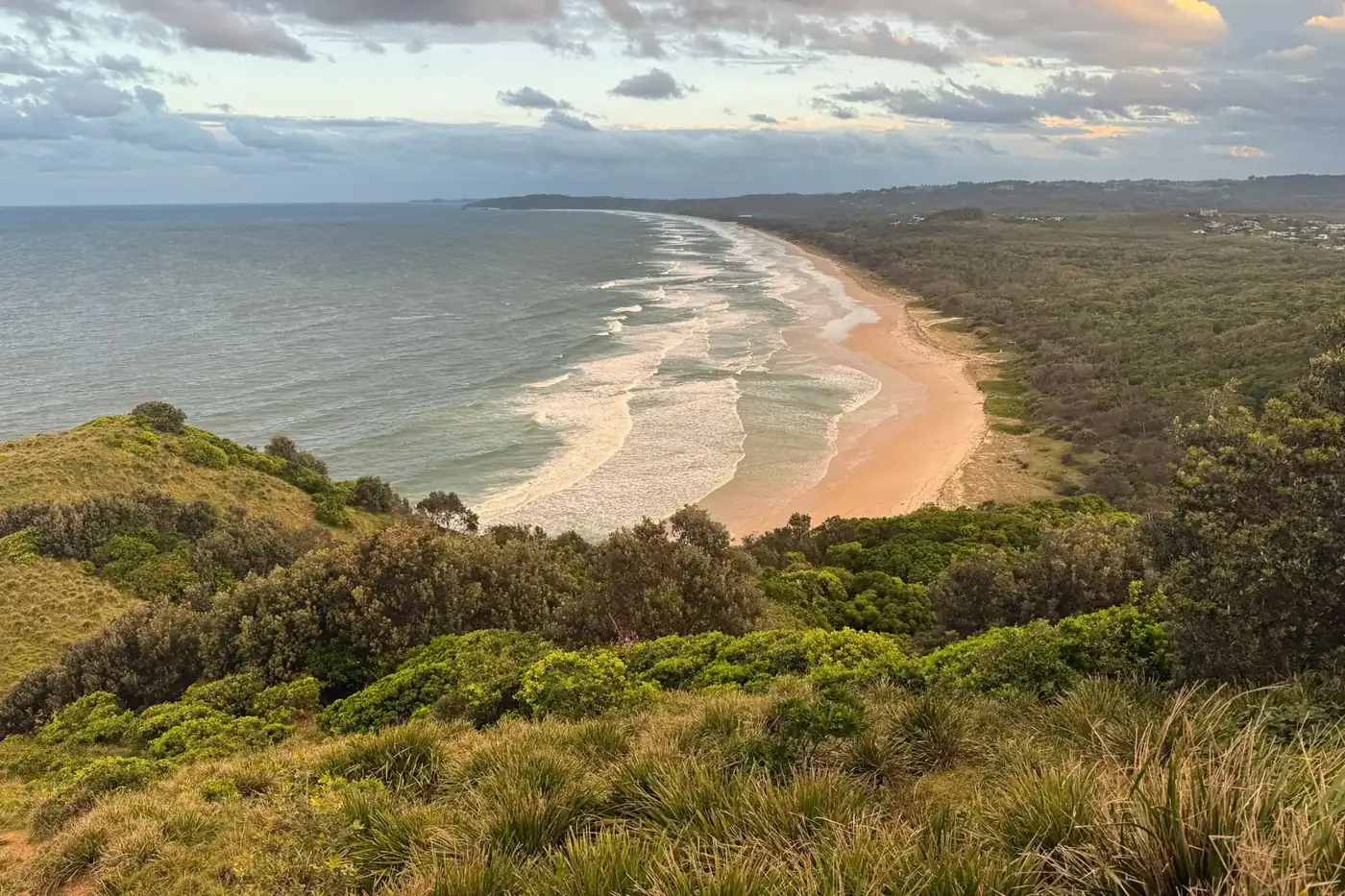
- The easterly point and Walgun Cape Byron Walking Track. This 3.7 km loop links rainforest, beach, grassland and the clifftops to the lighthouse.
- Wategos Beach. First called Little Beach, it is named after First World War veteran Mick Watego, whose family grew bananas and vegetables here from the 1930s.
- Julian Rocks (Nguthungulli). The park’s most important home for grey nurse sharks, with green, loggerhead and hawksbill turtles in good numbers.
Wildlife and plants to look for
- Humpback whales heading north in May and June, with the biggest numbers from late June through July. They swim south again from August to November, often with calves.
- Turtles, dolphins and stingrays below the walking track. Green turtles are the most common at Julian Rocks.
- Sea eagles, pelicans, brush-turkeys, and threatened wallabies near Wategos.
- Laurel trees, white lace flowers and basket ferns in the rainforest.
A little history
On 15 May 1770 James Cook named the cape after Captain John Byron, who had sailed around the world in the Dolphin. A timber jetty went out in 1888. The NORCO butter factory opened in 1895 and ran until 1972, and meatworks operated from 1912 to 1983. From 1954 to 1962 a whaling station took more than 1,100 humpbacks, until the hunt proved unsustainable. Then the surfers arrived. In 1961 filmmaker Bruce Brown and champion Phil Edwards filmed The Pass and Wategos, and through the 1960s more surfers followed. Slowly the town turned towards the sea.
Did you know?
The lighthouse carries a Latin motto, Olim periculum nunc salus: “Once dangerous, now safe”.
Its first light came from kerosene burning on six wicks, at 145,000 candela.
Keepers lived at the light until 1989. Their old office is now a maritime museum.
The Arakwal people and Cape Byron Marine Park agreed a memorandum of understanding in 2007.
Local surf-shop owner Bob Newland is credited with making Australia’s first surfboard leg-rope.
Travel with care
- Walgun is a place of ceremony. Stay on the tracks, and leave middens and shells where they lie.
- Swim only at patrolled beaches, between the red-and-yellow flags.
- Watch whales and dolphins from the headland or with licensed operators, never up close.
- The marine park has zones with different rules, so check them before fishing or collecting anything.
- The headland is busy at weekends, so arrive early for a quieter walk.
Journeys that take you here
More stories
Sources
- https://www.nationalparks.nsw.gov.au/visit-a-park/parks/cape-byron-state-conservation-area
- https://nationalparks.nsw.gov.au/visit-a-park/parks/cape-byron-state-conservation-area/learn-more
- https://www.nationalparks.nsw.gov.au/things-to-do/historic-buildings-places/cape-byron-lighthouse
- https://www.nationalparks.nsw.gov.au/things-to-do/walking-tracks/cape-byron-walking-track
- https://www.nationalparks.nsw.gov.au/things-to-do/picnic-areas/wategos-beach/learn-more
- https://www.nationalparks.nsw.gov.au/visit-a-park/parks/arakwal-national-park
- https://www.nationalparks.nsw.gov.au/get-inspired/stories/whale-migration-the-facts
- https://media.amsa.gov.au/cape-byron-lighthouse
- https://lighthouses.org.au/nsw/cape-byron-lighthouse/
- https://arakwal.com.au/country/
- https://www.dpird.nsw.gov.au/fishing/marine-protected-areas/marine-parks/cape-byron-marine-park
- https://www.dpird.nsw.gov.au/fishing/marine-protected-areas/marine-parks/cape-byron-marine-park/history-and-culture
- https://www.dpird.nsw.gov.au/fishing/marine-protected-areas/marine-parks/cape-byron-marine-park/life-under-the-sea/threatened-and-protected-species
- https://byronbayhistoricalsociety.org.au/history-trail/lighthouse/
- https://byronbayhistoricalsociety.org.au/history-trail/wategos-beach/
- https://byronbayhistoricalsociety.org.au/history-trail/whaling/
- https://byronbayhistoricalsociety.org.au/history-trail-2/
- https://byronbayhistoricalsociety.org.au/development-of-byron-bay/population/
- https://www.abc.net.au/news/2022-08-21/byron-bay-transformation-1970s-now/101343964