Springbrook National Park
On the rim of an ancient volcano, Gondwana's forests still grow and waterfalls pour from the cliffs.
Springbrook is the Country of the Yugambeh people. We acknowledge them as the Traditional Custodians of these mountains and pay our respects to their Elders past and present.
At a glance
- Where: Gold Coast hinterland, about 100 km south of Brisbane; four sections, roughly 6,558 hectares.
- Born of fire: shaped by the Tweed volcano about 23 million years ago.
- World Heritage: part of the Gondwana Rainforests of Australia, extended to Queensland’s Scenic Rim in 1994.
- Ancient trees: some Antarctic beeches here are around 3,000 years old.
- Wet and cool: more than 3,000 mm of rain a year.
The land and its first people
To the Yugambeh people, the mulei (mountains) are sacred places, to be nurtured and respected. They cared for this country with fire and traded rainforest products with coastal neighbours for shellfish, and they still care for it today. To the south rises Wollumbin (Mount Warning), a place of sacred ceremony for the Bundjalung nation. Its summit track stays closed in line with the wishes of its Aboriginal custodians.
Born of fire
Around 23 million years ago a great shield volcano centred on Wollumbin poured basalt lava across some 6,000 square kilometres. Later eruptions laid down the acidic rhyolite that forms Springbrook’s sheer cliffs. Over millions of years, rain and rivers wore the volcano’s heart into a vast bowl ringed by cliffs. UNESCO calls this Tweed Shield erosion caldera “possibly the best preserved erosion caldera in the world”. Springbrook sits on its northern rim.
What you will see
Best of All Lookout. A 600 m return path winds through a small pocket of Antarctic beech (Nothofagus moorei), one of our last living links to the forests of Gondwana. At the end, northern New South Wales opens below you, with Wollumbin at the centre and a crescent of cliffs sweeping to Lamington.
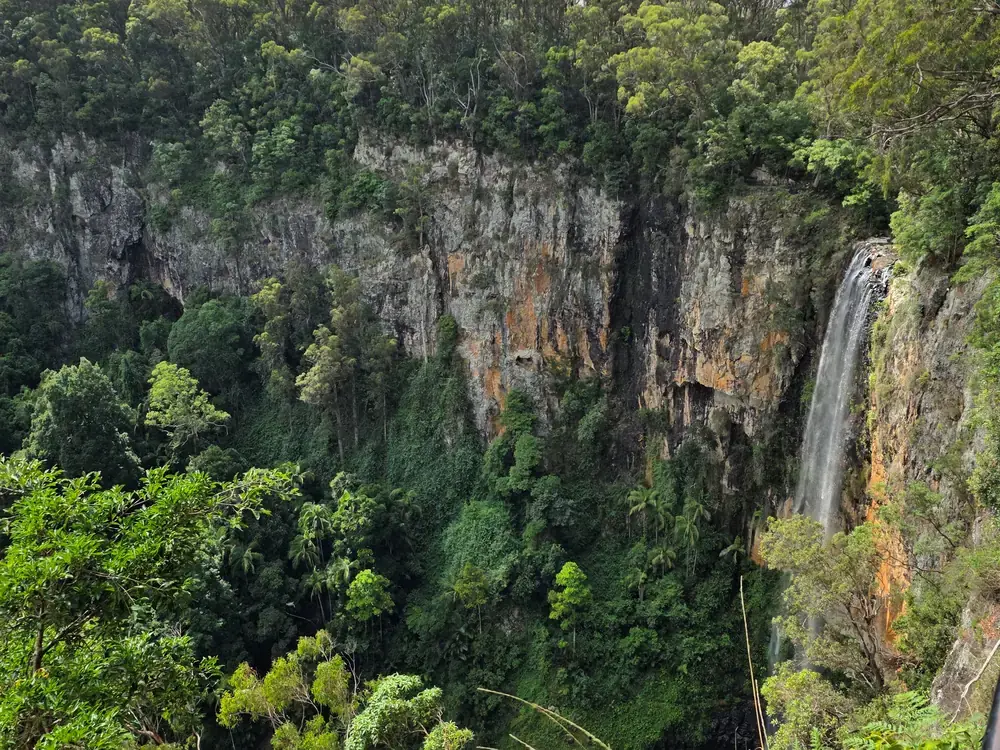
Purling Brook Falls. The brook cascades about 100 metres into a valley of palms and tree ferns. The 4 km circuit crosses the gorge on a suspension bridge.
Canyon Lookout and Twin Falls. A 30-metre stroll brings you to views of Twin and Rainbow Falls, The Canyon and the distant ocean. The Twin Falls circuit leads you behind two waterfalls and past brush box. Similar trees elsewhere in this World Heritage Area have been radiocarbon-dated at 1,500 years, the oldest ever dated this way on Australia’s mainland.
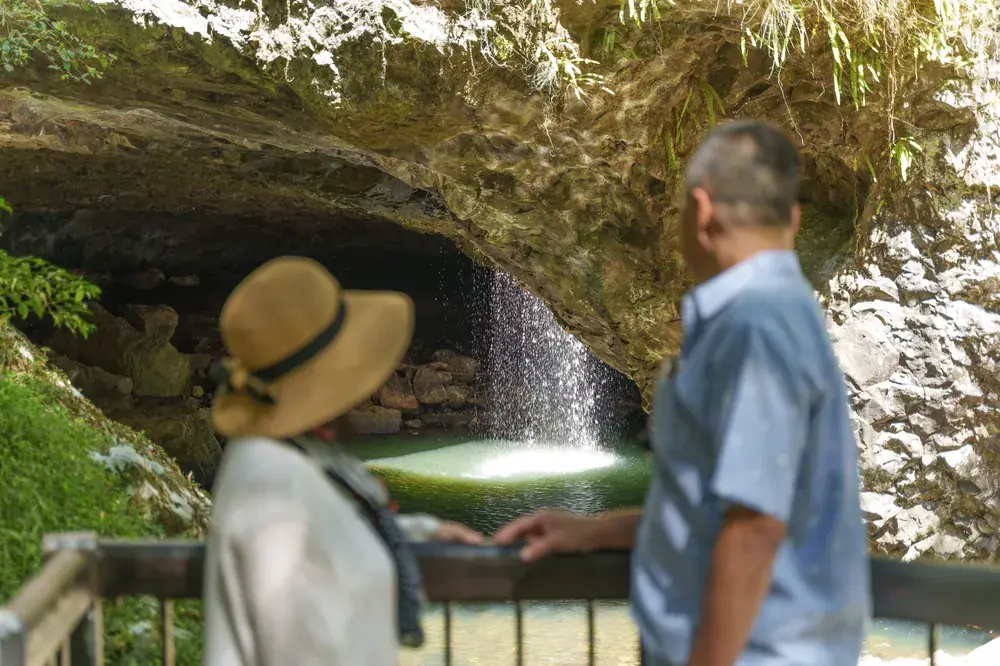
Natural Bridge. The arch was once the lip of a waterfall. Swirling water wore away the softer basalt beneath it to form a cave. Stones spinning in the creek bed above drilled a pothole that finally broke through. Now the creek plunges through it into the cave, where thousands of glow-worms shine after dark.
Life in the forest
Look for hoop pines, “living relics” of the Jurassic, and pink-trunked brush box. More than 100 bird species live here: listen for Albert’s lyrebird, a gifted mimic. Around Natural Bridge you may spot wompoo fruit-doves, green catbirds and paradise riflebirds. Pademelons (small rainforest wallabies) live here too, and the leaf-tailed gecko Saltuarius swaini is found nowhere outside this World Heritage Area.
A little history
Timber-getters arrived around the 1870s and called this the “Land of the Tall Timber”. In 1893 a giant red cedar was felled near Natural Bridge, and a section of it went on show at the 1900 Paris World Fair. Settlers followed in 1906. They were known as the Springwood Group, but their mail kept going to Springwood in the Blue Mountains, so they took “brook” from Purling Brook instead. By the 1930s dairying had cleared much of the forest; by the 1940s seven guesthouses were operating. Separate parks declared from 1937 onwards were joined as Springbrook National Park in 1990.
Did you know?
Natural Bridge is home to one of Australia’s largest glow-worm colonies.
A second pothole is forming above Natural Bridge and may one day break through.
The Gondwana Rainforests hold nearly all the world’s Antarctic beech cool temperate rainforest.
Springbrook’s sheer cliffs are rhyolite, from later eruptions.
Much of today’s forest is regrowth on old dairy land.
Travel with care
- Stay on the tracks and behind the barriers. The creek and its banks at Natural Bridge, and the top and base of Purling Brook Falls, are off limits and fines apply.
- Never shine a torch directly on glow-worms, and keep smoke and insect repellent away from them.
- Do not feed wildlife. Leave all plants, animals and rocks undisturbed.
- Start with clean footwear, keep sunscreen out of creeks and take rubbish home.
- Bring a raincoat and a warm layer. Pets are not permitted.
Journeys that take you here
More stories
Sources
- https://parks.qld.gov.au/parks/springbrook
- https://parks.qld.gov.au/parks/springbrook/about
- https://parks.qld.gov.au/parks/springbrook/about/culture
- https://parks.qld.gov.au/parks/springbrook/journeys
- https://parks.qld.gov.au/parks/springbrook/visiting-safely
- https://parks.qld.gov.au/parks/springbrook/about/cavecreek-restrictedaccess
- https://whc.unesco.org/en/list/368/
- https://www.environment.nsw.gov.au/topics/parks-reserves-and-protected-areas/protected-areas/world-heritage-listed-areas/gondwana-rainforests-of-australia
- https://www.nationalparks.nsw.gov.au/visit-a-park/parks/wollumbin-national-park
- https://experiencegoldcoast.com/places-to-go/hinterland-gold-coast/things-to-do/springbrook-plateau-springbrook-national-park-au0054696
- https://experiencegoldcoast.com/places-to-go/hinterland-gold-coast/things-to-do/natural-bridge-springbrook-national-park-au0053366
- https://www.goldcoaststories.com.au/purling-brook-falls/