Tamborine Mountain
A green island of volcanic rock above the Gold Coast, where Queensland's national parks began.
Tamborine Mountain (Jambreen) is the Country of the Yugambeh people. We also honour the Mununjali, Migunberri, Wangerriburra and Ugarapul Peoples, whom Scenic Rim Regional Council acknowledges as Traditional Owners of the Scenic Rim, and pay our respects to Elders past, present and emerging.
At a glance
- Where: Scenic Rim, about an hour from Brisbane and the Gold Coast; a plateau around 500 metres high with three villages.
- Born of fire: built from Tweed Volcano lava flows some 20 to 23 million years ago.
- A Queensland first: Witches Falls, declared on 28 March 1908, is the state’s oldest national park.
- Rich in life: the escarpment holds 85% of the animal species and 65% of the plant species found in the City of Gold Coast area.
The land and its first people
In the Yugambeh language the mountain is Jambreen. The Yugambeh Museum translates the name as “place of the finger lime and yam in a cliff”, and finger limes still grow wild here. The rainforest gave the Yugambeh food and materials. Piccabeen fronds made baskets for carrying water, food or honey, and lawyer-cane vine, stripped of its spikes, was woven too. Yugambeh people still walk the land of their ancestors.
Born of fire
A vast shield volcano centred on Wollumbin (Mount Warning) buried this country under layers of basalt lava. When the volcano died, water took over as sculptor. Where streams cut towards each other, sections of the dome were isolated as “land islands”, and Tamborine is one of them. The legacy is all around you: basalt columns, cliffs, waterfalls and rich red soil where avocados and kiwifruit grow.
The Australian Museum also records thunder eggs at Mt Tamborine. These spheres form in silica-rich volcanic rock such as rhyolite. A bubble of trapped gas grows radiating crystal fibres, then mineral-laden water fills its heart with agate, chalcedony, quartz or amethyst, often in a star-shaped pattern.
What you will see
Rainforest walks. The Witches Falls circuit (3.6 km) zigzags down through banksia forest into rainforest with giant strangler figs. At Curtis Falls (1.1 km), basalt columns stand beside a rock pool where glow-worms live. Palm Grove is lined with piccabeen palms.
Gallery Walk. Long Road at Eagle Heights offers crafts, soaps, Australian bushcraft, local produce, cafés and bakeries.
Tamborine Rainforest Skywalk. A 1.5 km trail includes 300 metres of steel bridges through the canopy and a 40-metre cantilever that hangs 30 metres above Cedar Creek.
Glow Worm Caves. At Cedar Creek Estate, a purpose-built cave opened in 2005 as the world’s first glow-worm sanctuary. It began with 300 glow-worms and now shelters more than 8,000, and you can see them by day.
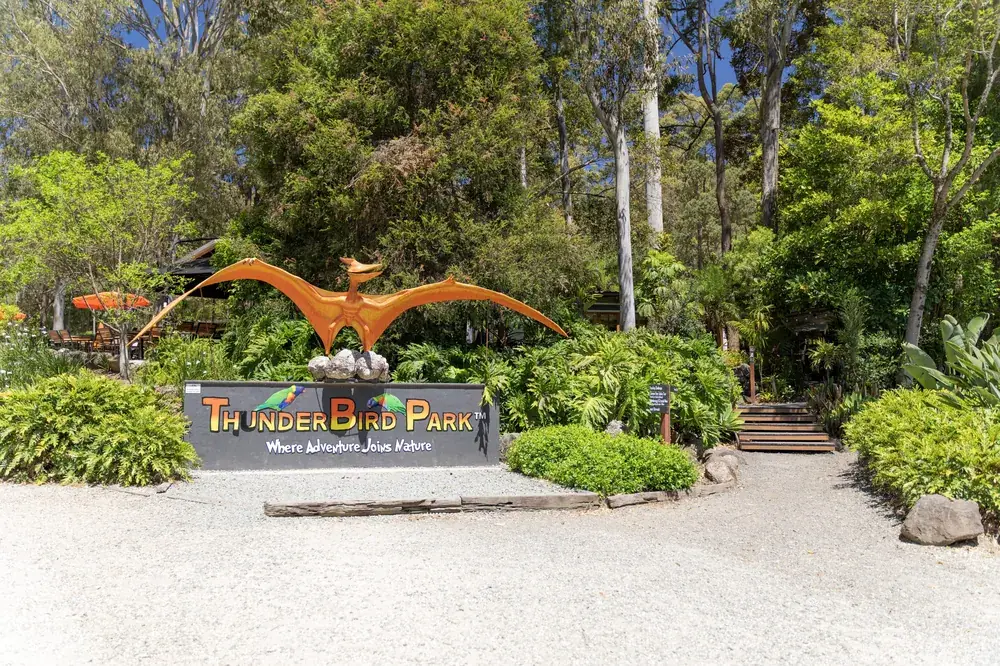
Thunderbird Park. Its thunder egg mine has been open to fossickers since 1967, and the park says only about a tenth has been dug.
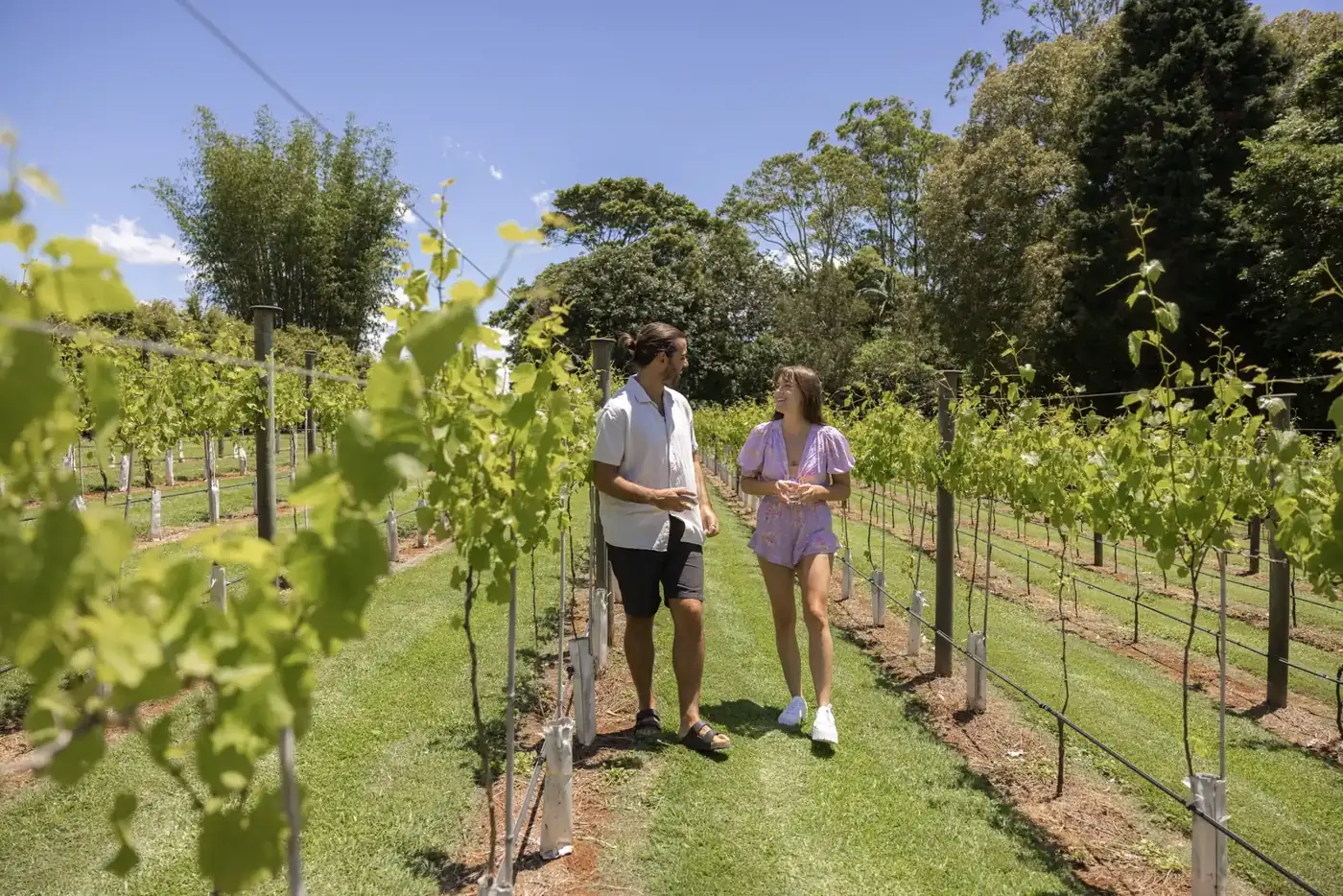
Cellar doors. Wine here is a young story. Mount Tamborine Vineyards & Winery dates from 1990. Cedar Creek Estate followed in 2000 and grows chambourcin and verdelho at about 550 metres. Jon and Kim Heslop founded Witches Falls Winery in 2003, making wine on site mostly from Granite Belt grapes.
Life in the forest
Look for red cedar and buttressed yellow carabeens. Listen for Albert’s lyrebird, an excellent mimic. Brush-turkeys and pademelons live here too, along with the land mullet, one of the world’s largest skinks. The Richmond birdwing butterfly and the noisy pitta are seasonal visitors.
A little history
The mountain opened for selection in 1878. That year, pastoralist Robert Martin Collins travelled overseas and was inspired by accounts of Yellowstone. He took his campaign into Parliament, and in 1906 the State Forests and National Parks Act was passed. Locals Sydney Curtis and Joseph Delpratt were alarmed at the clearing. In 1907 the council recommended protecting 154 hectares, and in 1908 Witches Falls became the first national park declared under the new Act.
Did you know?
More than 1,550 mm of rain falls on the mountain each year.
Witches Falls itself flows only after rain.
Queensland had large wine and table grape plantings by the mid-1800s.
Witches Falls Winery takes its name from the park.
A thunder egg keeps its crystals hidden until it is cut open.
Travel with care
- Keep to the tracks and watch children near lookouts and steep edges.
- The Curtis Falls rock pool is off limits (penalties apply) to protect visitors, glow-worms and platypus.
- Never jump into creeks, and keep out of creek water after heavy rain.
- There are no bins in the park, so take your rubbish home. Pets are not allowed.
- Photography and artificial light are not allowed in the glow-worm cave.
Journeys that take you here
More stories
Sources
- https://parks.qld.gov.au/parks/tamborine
- https://parks.qld.gov.au/parks/tamborine/about
- https://parks.qld.gov.au/parks/tamborine/about/culture
- https://parks.qld.gov.au/parks/tamborine/things-to-do
- https://parks.qld.gov.au/parks/tamborine/visiting-safely
- https://www.yugambeh.com/faq
- https://www.scenicrim.qld.gov.au/home/acknowledgement-country
- https://www.scenicrim.qld.gov.au/Our-Community/About-Scenic-Rim/Towns-and-Villages/Tamborine-Mountain
- https://www.visitscenicrim.com.au/tamborine-mountain/
- https://australian.museum/learn/minerals/shaping-earth/concretions-thunder-eggs-and-geodes/
- https://www.thunderbirdpark.com/
- https://www.thunderbirdpark.com/thunderegg-fossicking/
- https://skywalktamborine.com/
- https://www.rainforestskywalk.com.au/
- https://www.tamborineglowworms.com.au/
- https://www.tamborineglowworms.com.au/conservation.html
- https://www.tamborineglowworms.com.au/faqs.html
- https://cedarcreekestate.com.au/glow-worms/
- https://winecompanion.com.au/wineries/queensland/queensland-zone/cedar-creek-estate
- https://winecompanion.com.au/wineries/queensland/granite-belt/mount-tamborine-vineyards-winery
- https://www.winecompanion.com.au/wineries/queensland
- https://witchesfalls.com.au/pages/our-story