

Green Mountains
Lamington National Park & O'Reilly's
High in an ancient rainforest, where lyrebirds sing and a mountain family's legend began.
Trekoora acknowledges the Yugambeh people and their family groups, including the Wangerriburra, Traditional Custodians of the mountains known in the Yugambeh language as Woonoongoora, and pays respect to their Elders past and present.
The land and its first people
In the Yugambeh language these mountains are Woonoongoora, places that are “sacred and spiritual, places to be nurtured and respected”. The Yugambeh family groups include the Wangerriburra, Birinburra, Gugingin, Migunberri, Mununjali, Bollongin, Minjungbal and Kombumerri. Near Binna Burra, Kweebani (“cooking”) cave is evidence of their long presence. A traditional pathway is believed to have crossed the park’s southern section, running from northern New South Wales to the Bunya Mountains. The park’s great campaigner, Romeo Lahey, wanted to call it Woonoongoora.
The nature story
About 20 to 23 million years ago, the Tweed shield volcano shaped this country. Its erosion caldera, the vast bowl left as the volcano wore away, is the largest and best example of its age in the world. The World Heritage Area that Lamington belongs to holds the most extensive subtropical rainforests on Earth. Lamington also protects nearly all of the northernmost Antarctic beech cool temperate rainforest. These are living links to ancient Gondwana. UNESCO notes that old songbird families survive here, including lyrebirds, scrub-birds, treecreepers and bowerbirds.
What you will see
- O’Reilly’s, Green Mountains. In 1911 eight O’Reilly men arrived on what was then called Green Mountains. At Easter 1926 they welcomed their first paying guests.
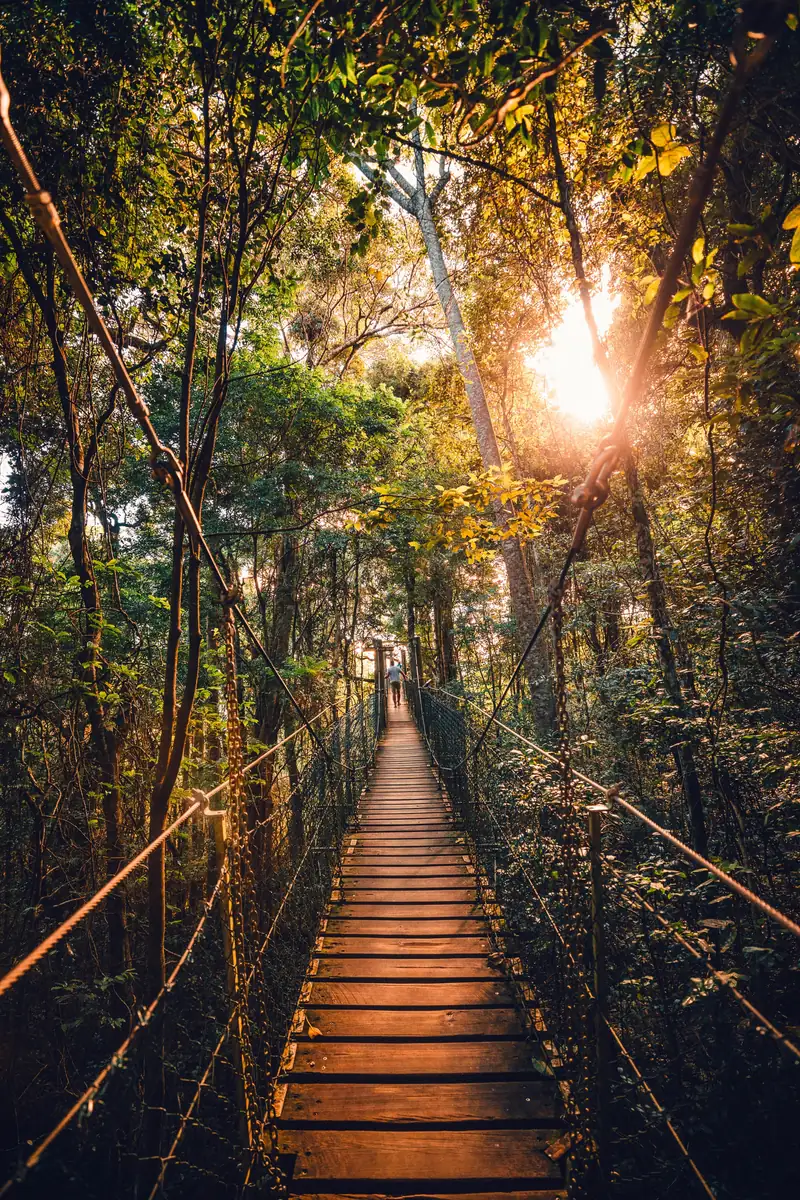
- The Tree Top Walk. Peter “Big Pete” O’Reilly created it in 1987, and O’Reilly’s calls it Australia’s first tree top walk. Nine suspension bridges stretch 180 metres, about 15 metres above the forest floor. A ladder climbs a strangler fig, and the highest deck stands about 30 metres up.
- Binna Burra. Romeo Lahey and Arthur Groom led the first camps here in 1933. In September 2019 bushfires destroyed all the cabins but one. When the road reopened on 31 August 2020, most of Binna Burra’s rainforest trails reopened too.
- Rainforest tracks and lookouts. Named tracks include Morans Falls, Python Rock and the Border Track. From the lookouts you see the Gold Coast, south-east Queensland and northern New South Wales.
Wildlife and plants to look for
- Albert’s lyrebird, often met in the cooler months. The male’s song imitates sounds of the forest.
- The regent bowerbird, brilliant black and gold, often seen foraging.
- The crimson rosella, in vivid red and blue.
- Satin bowerbirds, rufous scrub-birds and eastern bristlebirds.
- Antarctic beech, hoop pine (one of the world’s oldest conifers), and giant brush box trees.
A little history
Robert Collins began the campaign for a park here in 1878, after learning of Yellowstone. From 1911 Romeo Lahey lobbied, lectured and petitioned until the park was declared in 1915, named after Queensland Governor Lord Lamington. On 19 February 1937 a Stinson airliner, the City of Brisbane, flying from Brisbane to Sydney, vanished in severe weather. Bernard O’Reilly used his knowledge of the ranges, and reports from the valley, to guide his search. Nine days after the crash he reached the wreckage and found two survivors, Joe Binstead and John Proud. A fellow passenger, James Westray, had died going for help.
Did you know?
- 1
Some brush box trees here have been radiocarbon dated at 1,500 years, the oldest ever carbon-dated on mainland Australia.
- 2
The park protects about 58 plants and more than 22 animals that are vulnerable, rare or threatened.
- 3
Early guests took two days to reach O’Reilly’s, by car, train and horseback.
- 4
Lahey and Groom also founded the National Parks Association of Queensland in 1930.
- 5
O’Reilly’s sits about 930 metres above sea level.
See it with a private host
Tell us your dates and who is travelling, and we plan a private day around this place.
Take the story with you
Four printable pages with the history, the nature and what to look for on the day. Scan its code to come back here.
More stories

Gold Coast hinterland
Springbrook National Park
On the rim of an ancient volcano, Gondwana's forests still grow and waterfalls pour from the cliffs.

After dark in the rainforest
The Glow-worms of the Gold Coast Hinterland
After dark, a rainforest cave ceiling turns into a sky of tiny blue-green stars.

Gold Coast hinterland
Tamborine Mountain
A green island of volcanic rock above the Gold Coast, where Queensland's national parks began.
Sources
- https://parks.qld.gov.au/parks/lamington/about
- https://parks.qld.gov.au/parks/lamington/about/culture
- https://parks.qld.gov.au/parks/lamington/things-to-do
- https://whc.unesco.org/en/list/368/
- https://oreillys.com.au/a-century-on-the-mountain-the-story-of-oreillys-rainforest-retreat/
- https://oreillys.com.au/oreillys-rainforest-retreat/
- https://oreillys.com.au/activity/treetop-walk/
- https://www.visitscenicrim.com.au/canungra-and-beechmont/attraction/oreillys-tree-top-walk/
- https://www.binnaburralodge.com.au/history/
- https://statements.qld.gov.au/statements/90603